
While going up from the foothills into the Kanchenjunga Conservation Area in Nepal, you witness shifting terrains, vegetation, temperatures, and cultures. It feels like an amalgamation of landscapes: Fiordland National Park of New Zealand (without the sea, of course) and the alpine Himalaya. A place so mystical (and mythical), so high, so intimidating, so treacherous, so dangerous, that it feels like no place for mortals like us. The air is thin, and these massive, massive giants stand all around you. Photographing them feels like a futile process.
What draws me into these high places, I ask myself, when I know these are not places for mortals? I consider it like a penance — a spiritual undertaking, a pilgrimage. The peaks decide whether to reward me for my efforts: the reward being their almighty darshan (a Sanskrit word denoting the moment in Hinduism when a devotee both sees and is blessed by the divine entity). Lessons in slow gratification and patience. It’s a vicious cycle of hope, elation, despair, and humility. Also a journey inwards: a test of mental fortitude, a review of my personal state — growth, maturity, and understanding. And a report card of my health: physical and mental alike. More often than not, these journeys have set the stage for the upcoming milestones of my life: some large, some small yet deeply effective.


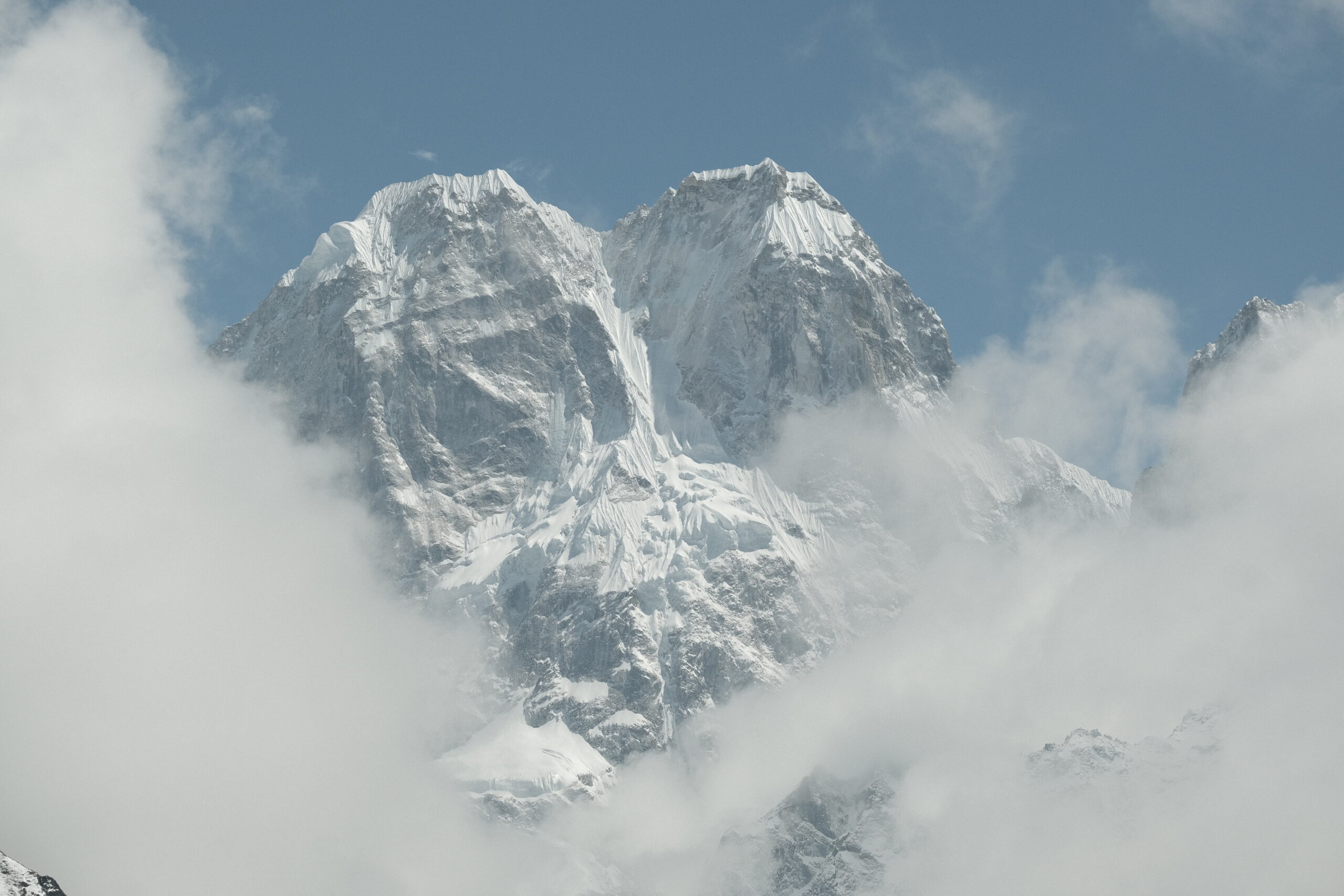
During the planning phase of this trek, viewing Jannu (also called Kumbhakarna) peak up close was high on my priority list. Notoriously difficult to climb, the north face of this intimidating mountain presents the ultimate test for alpine climbers. As I was ascending at around 4,500m, I spotted a sign reading “Jannu Viewpoint,” with an arrow pointing to the right. I assumed there was a path to a base camp nearby — but what truly struck me was when I looked up in that direction. There it was: the formidable mountain standing high into the sky, shaped like a dark, brooding deity — batman-esque, if you will (not the right comparison, I know; you don’t mix mythology with American superheroes). A god nevertheless. An acclimatisation hike to the Jannu Base Camp the next day was a huge highlight of my trek. I got the opportunity to sit in the lap — barring the Jannu Glacier — of three giants: Jannu (7710m), Sobithonge (6645m), and Kabur (6294m).


Now, about the weather — which has a huge say in these places. I was fortunate to have clear skies and plenty of sun in the first half of every day, followed by snowfall on every afternoon at higher altitudes. This meant navigating through fresh snow the next morning, despite clear views of the mountain peaks. Hiking in snow and ice requires double the time and effort. It snowed relentlessly at the camp before Kanchenjunga North Base Camp. The direct sun on ice triggered rockfalls, making conditions increasingly tricky. Having to cover around 900m hopping over boulders and navigating through landslide debris in severe rockfall zones — without pause — was both hair-raising and treacherous.


The background: The reason I chose Kanchenjunga North Base Camp (from the Nepal side) is that I wanted to complete a circle — a circle I started way back in 2009, when I attempted to trek to the Kanchenjunga valley from the Indian side. Had I completed it back then, it would have been the southeast face of Kanchenjunga. But I was a novice then, on my very first Himalayan trek. As a student with no income, coming off a difficult year, I had to borrow the ill-fitting jackets from my cousins with no experience of layering for high-altitude conditions. My hope was that, given where I am in life now, I would finally be able to close this circle and complete this unfinished pilgrimage.


The final part: THE KANCHENJUNGA. This was the day I found myself unusually disciplined — not clicking a single photo despite having my camera lugged around my neck. The only reason: I had to get to the base camp to catch a glimpse of Kanchenjunga before the clouds rolled in. It was a clear sky, but you never know in the mountains. Kanchenjunga, like all gods, would only reveal itself from the end point of the hike — emerging from behind other great peaks at a certain point along the trail. From a distance, I could see a patch of clouds rolling in behind me from down the valley. It felt almost like a race against them. Given the conditions described above, I was of course defeated. I was so close to the base camp, but the clouds engulfed the entire valley. It was a dagger to my heart. The trail kept going into the mist, feeling almost never-ending. I was close to tears, knowing I had hiked nearly five hours — and yet would not get to witness Kanchenjunga.

From my experience of hiking in the Himalaya so far, I’ve never had clouds clear mid-way through the day. But this almost felt like a miracle. Through the mist, I could see a pointed peak high up; surely Kanchenjunga. At this point, I would have been content with just this view as it felt like the reward for all the months of planning, preparation, and effort. It was unforgettable, and I clicked my first photo of the day. But it just got better! The entirety of the mist cleared and there they stood. Kanchenjunga Main (8,586m) and Yalung Kang (Kanchenjunga West, 8,505m). So did the panorama views of other peaks; like an amphitheatre.

